


Why Incoming Moisture Content Matters
With rising energy costs continuing to put pressure on biomass businesses, optimising your woodchip drying operation is becoming increasingly important.
One commonly misunderstood aspect of drying is the relationship between incoming moisture and the amount of water that must be evaporated to reach the desired dry output. Even a relatively small increase in moisture content can add significantly to the drying workload, affecting energy demand, processing capacity and operating costs.
For sawmills, wood fuel producers and biomass processors, understanding this relationship is essential to optimising woodchip drying throughput. Read on to learn more.
Note - woodchip drying is a complex process influenced by several interdependent factors, many of which do not follow a linear relationship. This article focuses on just one element of that process to illustrate its impact on drying performance. Other factors are also crucial and a more detailed assessment of your operation is always beneficial to identify opportunities to optimise throughput, energy efficiency and operating costs.
Understanding the Woodchip Drying Curve
The woodchip moisture removal graphic below illustrates how much water must be removed as maple woodchips are dried from 50% to 10% moisture content. Processing 3.5 m³ of incoming woodchips per hour requires the following water removal rates across 4 drying stages:
Stage 1: 50% to 40% moisture: 315 litres at 3.5m³ per hour
Stage 2: 40% to 30% moisture: 225 litres at 3.5m³ per hour
Stage 3: 30% to 20% moisture: 169 litres at 3.5m³ per hour
Stage 4: 20% to 10% moisture: 135 litres at 3.5m³ per hour
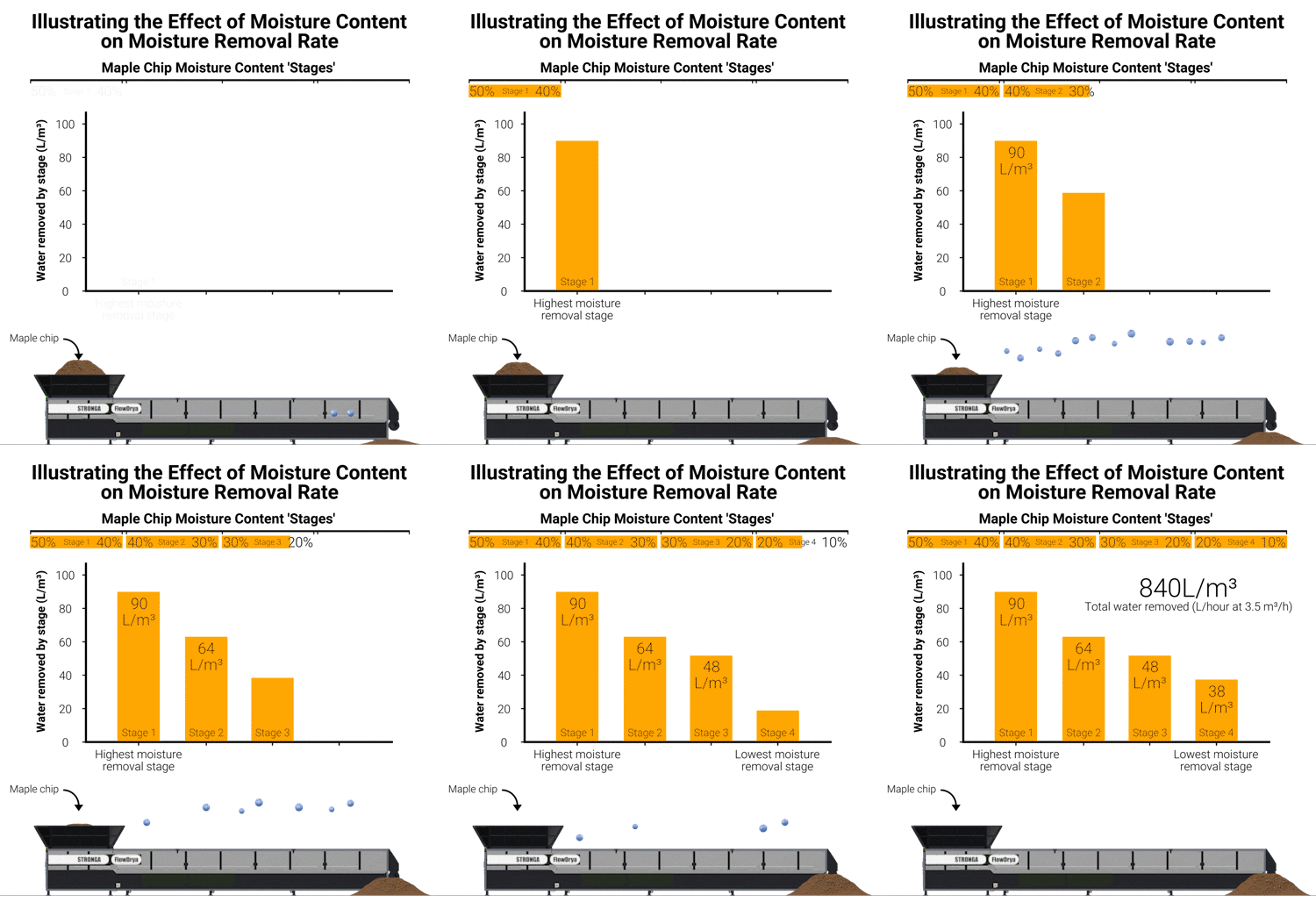
This highlights a crucial point: the workload varies throughout the drying process. Stage 1 requires the greatest amount of water to be removed, whereas the final reduction in moisture content from 20% to 10% represents a considerably lower drying load.
• Higher energy input is required to heat the incoming chips and the water they contain, bringing the moisture to the temperature required for evaporation.
• Longer residence time on the dryer bed is required to remove the greater volume of water and achieve the target moisture content.
The combined effect is a significant increase in both energy demand and drying time. This is often compounded during colder periods of the year, when the incoming chips are also at a lower temperature, further increasing the energy required to bring them up to the necessary drying temperature.
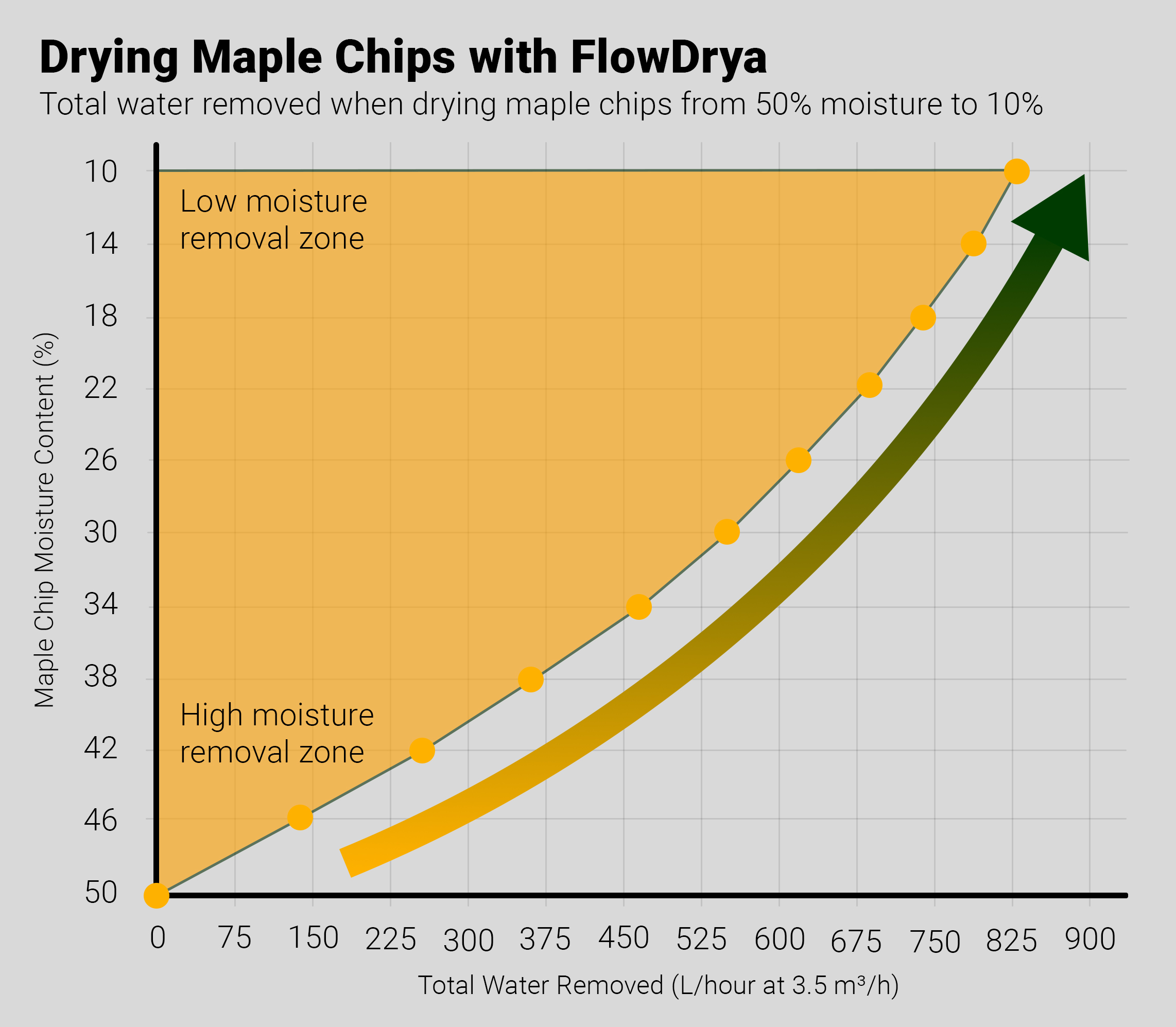
Across the complete process, approximately 240 litres of water must be removed per cubic metre of incoming woodchips to achieve the 10% target moisture content. At 3.5 m³/h, that represents approximately 840 litres of water evaporated every hour.
The wetter the incoming material, the more water the drying system must remove. Where drying capacity is limited, this additional workload will reduce the volume of material processed to specification in a given period.
12 Ways to Reduce Chip Moisture Pre-FlowDrya
Of course, you cannot control the moisture content of incoming timber, particularly during wetter months when moisture will always naturally be higher. However, improvements to harvesting, processing and storage can help reduce unnecessary moisture and make drying more efficient. Below are some tips for consideration.
1. Season roundwood before chipping where practical, allowing natural moisture loss.
2. Harvest in dry weather to reduce surface water on timber.
3. Chip in favourable weather to minimise exposure to rainfall.
4. Store woodchips under cover to protect them from rain and snow.
5. Use roofed storage with open sides to combine weather protection with airflow.
6. Chip directly into covered storage to reduce exposure immediately after processing.
7. Keep woodchips off wet ground using concrete or another suitable impermeable surface.
8. Allow airflow through chip piles rather than compacting material tightly.
9. Manage pile size to reduce the risk of heat build-up and uneven moisture migration.
10. Separate batches by moisture content to avoid mixing wetter material with drier stock.
11. Rotate stock using first-in, first-out principles to avoid unnecessarily long storage periods.
12. Avoid chipping waterlogged timber where it can first be drained or seasoned.
Individually, these measures may deliver modest improvements. Combined, they can help reduce incoming moisture, improve batch consistency and ease the workload placed on your dryer.
Improve Chip Drying Efficiency with FlowDrya
Even with good material management, wet woodchips are often unavoidable. The key is having a drying system that makes effective use of the energy available to your operation.
Stronga's FlowDrya is the world’s leading biomass dryer, designed to use direct fuel or residual heat from combined heat and power (CHP) plants, biomass boilers and other thermal energy systems. By reducing feedstock moisture before the next stage of processing (pyrolysis, boiler fuel or other), FlowDrya helps businesses make better use of available thermal energy and prepare biomass for higher-value applications.
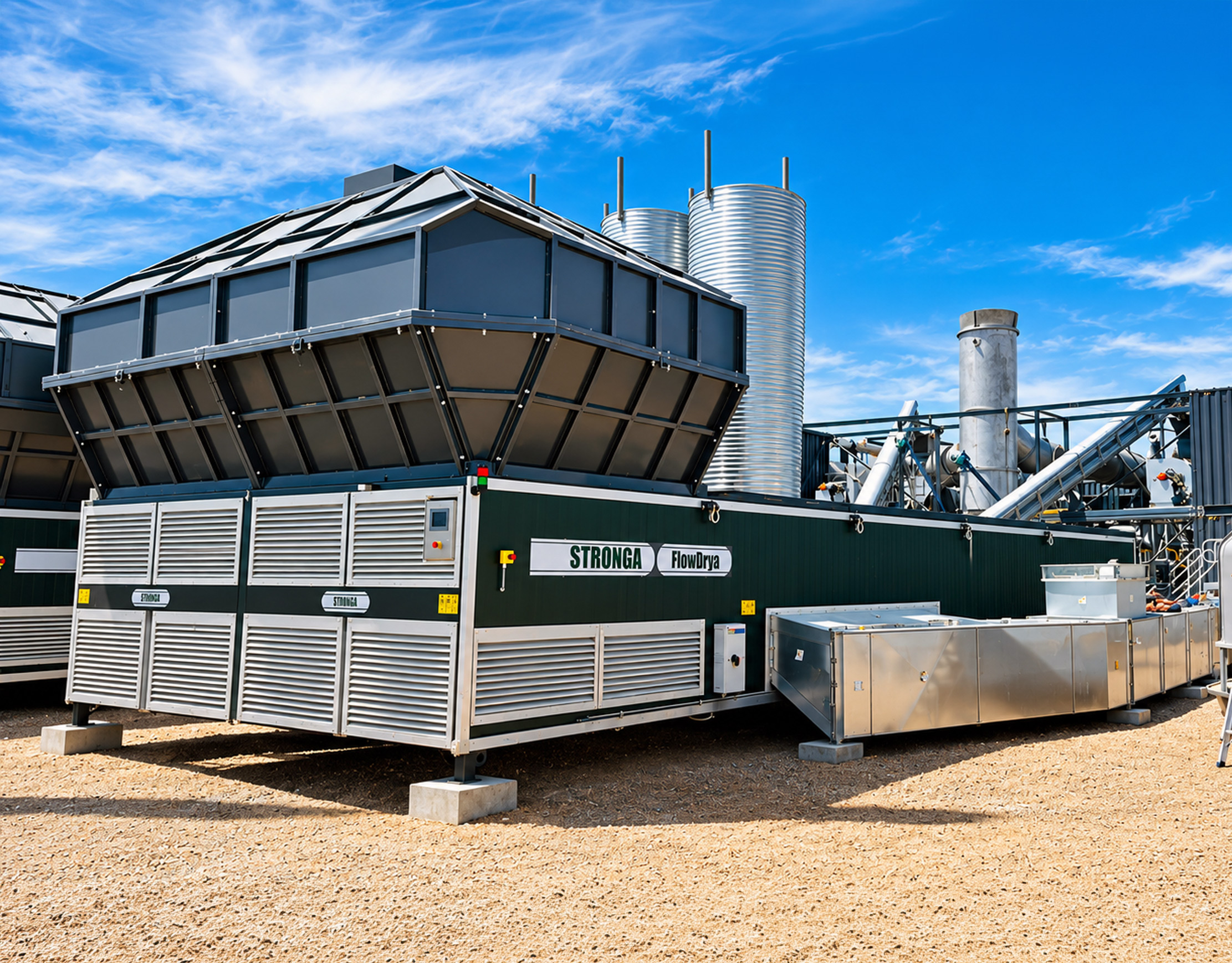
For wood fuel producers, drying can improve fuel quality and increase usable energy per tonne. For pyrolysis operators, reducing feedstock moisture limits the water that must be evaporated inside the reactor, helping reduce the thermal burden on the downstream process.
In biochar production, effective feedstock preparation supports a consistent process, although final carbon content, yield and carbon-credit eligibility also depend on reactor conditions, feedstock characteristics, product testing and certification requirements.
Make every unit of thermal energy work harder. Contact Stronga to discuss your woodchip drying requirements and discover how FlowDrya could help optimise throughput and unlock greater value from your biomass.
Email: enquiries@flowdrya.com



Share this post